> For the complete documentation index, see [llms.txt](https://help.smartico.ai/welcome/llms.txt). Markdown versions of documentation pages are available by appending `.md` to page URLs; this page is available as [Markdown](https://help.smartico.ai/welcome/technical-guides/integration-process.md).
# Integration process
On this page, you will find the basic information about the integration process between clients and Smartico.
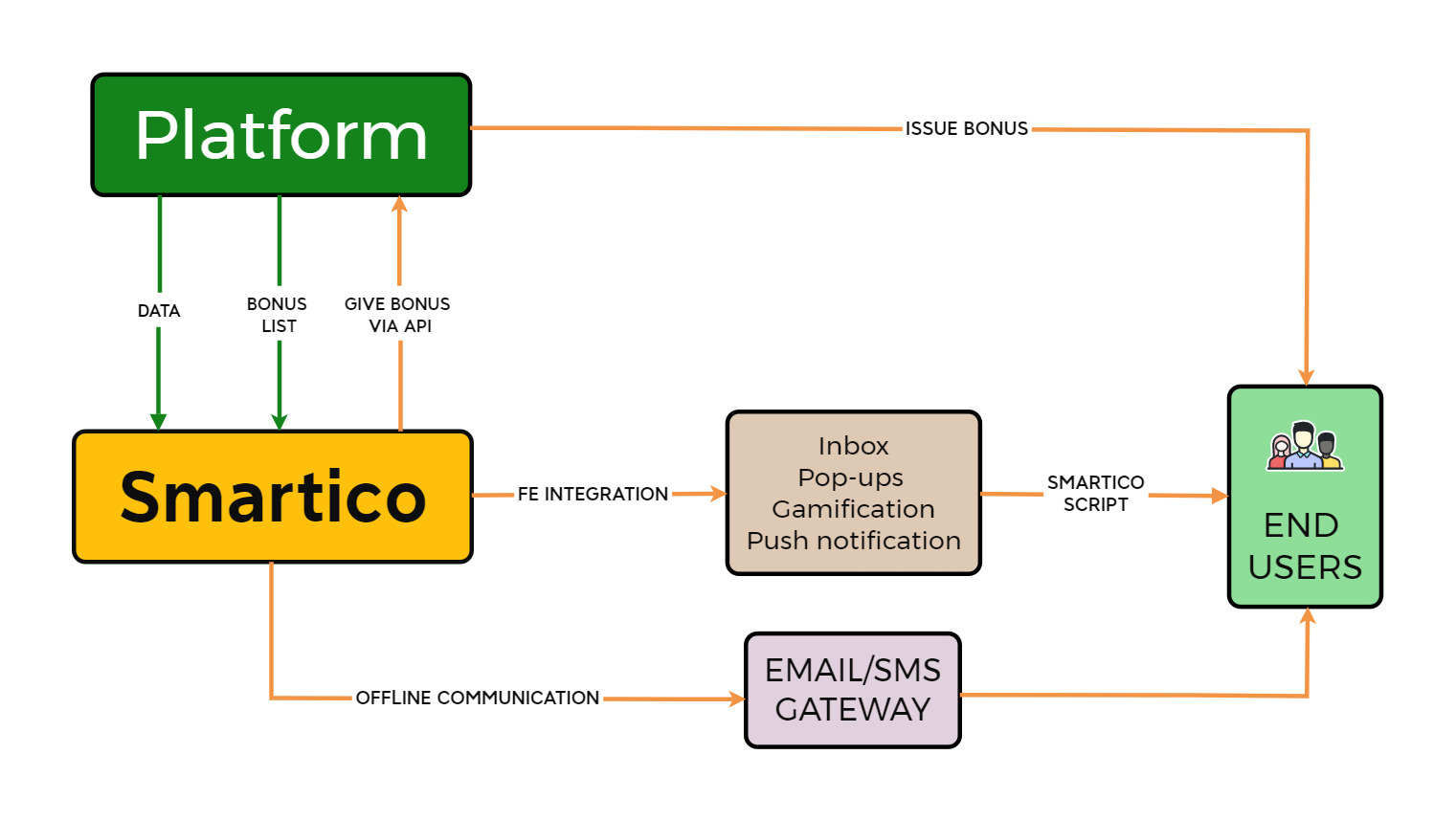
The integration process between Smartico and clients consists of 4 main points - Data integration, Front-end Integration, Bonus Integration, and Offline Communication.
Here are the mechanics behind the main integration points:
**Data Integration** - The data is coming from the platform side to Smartico. Smartico can be integrated with your product in 3 ways:
* By sending server-to-server events to Smartico REST API about end-user actions and updates in the end-user profile.
* By providing access to a replica of your database with a set of views representing the data to synchronize. The Smartico system connects to your database and tracks changes in the views.
* By providing access to your event streaming platform (e.g., Kafka or RabbitMQ), with documentation related to the required events and data.
{% embed url="" fullWidth="false" %}
Read more about Data Integration
{% endembed %}
**Bonus Integration** - Smartico gets the list of available bonuses from the platform and issues bonuses through the platform API. The general logic of such an API looks like "Give bonus X to user Y", where bonus X is identified by a unique name or ID, and the details of the bonus are managed on the side of the integrated system.
For example: For a Casino product, the bonus can be identified as "10FREE\_SPIN\_IN\_GOLDEN\_SLOT". Information about the number of spins and eligible games is managed on the Casino system side, and the Smartico system will only instruct the casino through the API to give 10FREE\_SPIN\_IN\_GOLDEN\_SLOT to the user John1984.
{% embed url="" %}
Read more about Bonus API Integration
{% endembed %}
In addition to fixed bonus templates, Smartico supports **Dynamic Bonuses and Variable Rewards** (such as cashback percentages, formula-calculated bonus amounts, and jackpot payouts), where Smartico passes dynamic amount and parameter values directly to the platform API.
{% embed url="" %}
Read more about Bonuses
{% endembed %}
**Front-end & Mobile Integration** - The popups, gamification widgets, web push, inbox, and online status tracking are exposed to end users through the Smartico client libraries. For web and WebView wrapper applications, the Smartico JavaScript library is embedded across site pages, and native device push tokens can be registered using dedicated token registration methods. For native iOS and Android mobile apps, Smartico provides native WebSocket integration protocols, Swift and Kotlin SDKs, and an open-source React Native SDK.
{% embed url="" %}
Read more about FE Integration
{% endembed %}
**Games Catalog Integration** - Smartico synchronizes your Casino games catalog to link games directly with Missions, Tournaments, and Jackpots. The catalog can be ingested via a public REST API or database view providing game names, IDs, thumbnail images, categories, and game launch URLs (or front-end launch callbacks). Games Catalog integration is a mandatory requirement for Jackpots to track eligible games and calculate contributions.
{% embed url="" %}
Read more about Games Catalog API
{% endembed %}
**Communication Gateways** - Smartico connects with external delivery providers to send messages across multiple channels, including Email, SMS, Instant Messaging (WhatsApp, Telegram, Viber, RCS), and Mobile/Web Push notifications. Operators can connect third-party provider accounts or implement a Secured Messaging Gateway (Zero-PII mode) to route messages through client-hosted endpoints without sharing player email addresses or phone numbers with Smartico.
{% embed url="" %}
Read more about Secured Email/SMS Gateway
{% endembed %}
{% embed url="" %}
Read more about Opt-out and Communication Statuses
{% endembed %}
{% embed url="" %}
Read more about Communication Gateways
{% endembed %}
### Frequently Asked Questions
**Can we send additional event types or user properties after the initial integration is completed?**
Yes. You can start sending new standard or custom event types and user profile properties to the REST API or streaming feed at any time following the integration data contract. No additional development or redeployment is required from Smartico as long as the event payloads match the configured label setup.
**Do Dynamic Rewards and Jackpots require a specific bonus integration?**
Yes. Fixed bonus integrations only support passing pre-configured template IDs with fixed amounts. Dynamic Rewards (such as cashback or formula-based bonuses) and Jackpots require a variable-amount bonus API integration that allows Smartico to pass dynamic amount, currency, and parameter values at issuance time.
**How can we verify that our integration events and API requests are working properly?**
Technical teams can inspect incoming payloads, event timestamps, and validation errors in real time using the Back-Office system logs and debug tools. If an API call fails with errors such as an unsupported event type or unrecognized brand identifier, the error logs provide the exact error code and rejected payload details.
**Where can we see which platform integrations are on for our label?**
In the **Integration products (platforms)** setting in **Label settings**. It lists the integrations with your platforms that are on for the label, for example the casino or sportsbook platform. Smartico engineers set it during the integration; ask your Success manager to change it.
---
# Agent Instructions
This documentation is published with GitBook. GitBook is the documentation platform designed so that both humans and AI agents can read, navigate, and reason over technical content effectively. Learn more at gitbook.com.
## Querying This Documentation
If you need additional information that is not directly available in this page, you can query the documentation by asking a question.
Perform an HTTP GET request on the following URL with the `ask` and `goal` query parameters:
```
GET https://help.smartico.ai/welcome/technical-guides/integration-process.md?ask=&goal=
```
`ask` is the immediate question: it should be specific, self-contained, and written in natural language.
`goal` is what the user is ultimately trying to achieve, the reason they need the answer. Sharing it helps GitBook give you a better, more relevant answer. A goal is most helpful when it describes the outcome the user wants rather than restating the question. For example, with `ask=how do I create an API token`, a goal like `automate deployments from our CI pipeline` lets GitBook tailor the answer to that use case.
The response will contain a direct answer to the question and relevant excerpts and sources from the documentation.
Use this mechanism when the answer is not explicitly present in the current page, you need clarification or additional context, or you want to retrieve related documentation sections.