> For the complete documentation index, see [llms.txt](https://help.smartico.ai/welcome/llms.txt). Markdown versions of documentation pages are available by appending `.md` to page URLs; this page is available as [Markdown](https://help.smartico.ai/welcome/products/crm-automation/a-b-testing.md).
# A/B Testing
This document describes the specifics of A/B Testing and how to use it with Smartico.
A/B testing is a method used to compare two versions of a marketing asset to determine which one performs better. In this process, the audience is divided into two groups, and each group is shown a different version (Version A and Version B) of the marketing asset.
With Smartico, you can conduct A/B testing across various communication channels including email, pop-up, inbox, SMS, and push notifications. The purpose is to determine which version generates a better response in terms of the desired outcome, such as positive interactions (e.g. deposits) and conversion rate for example.
To do an A/B testing for a specific marketing asset you need to start by preparing the desired resources and the variations for it. For example, if you want to compare 2 versions of pop-ups that promote a 10% cashback bonus on deposit you should first create 2 different pop-ups and then you can easily attach them to the campaign.
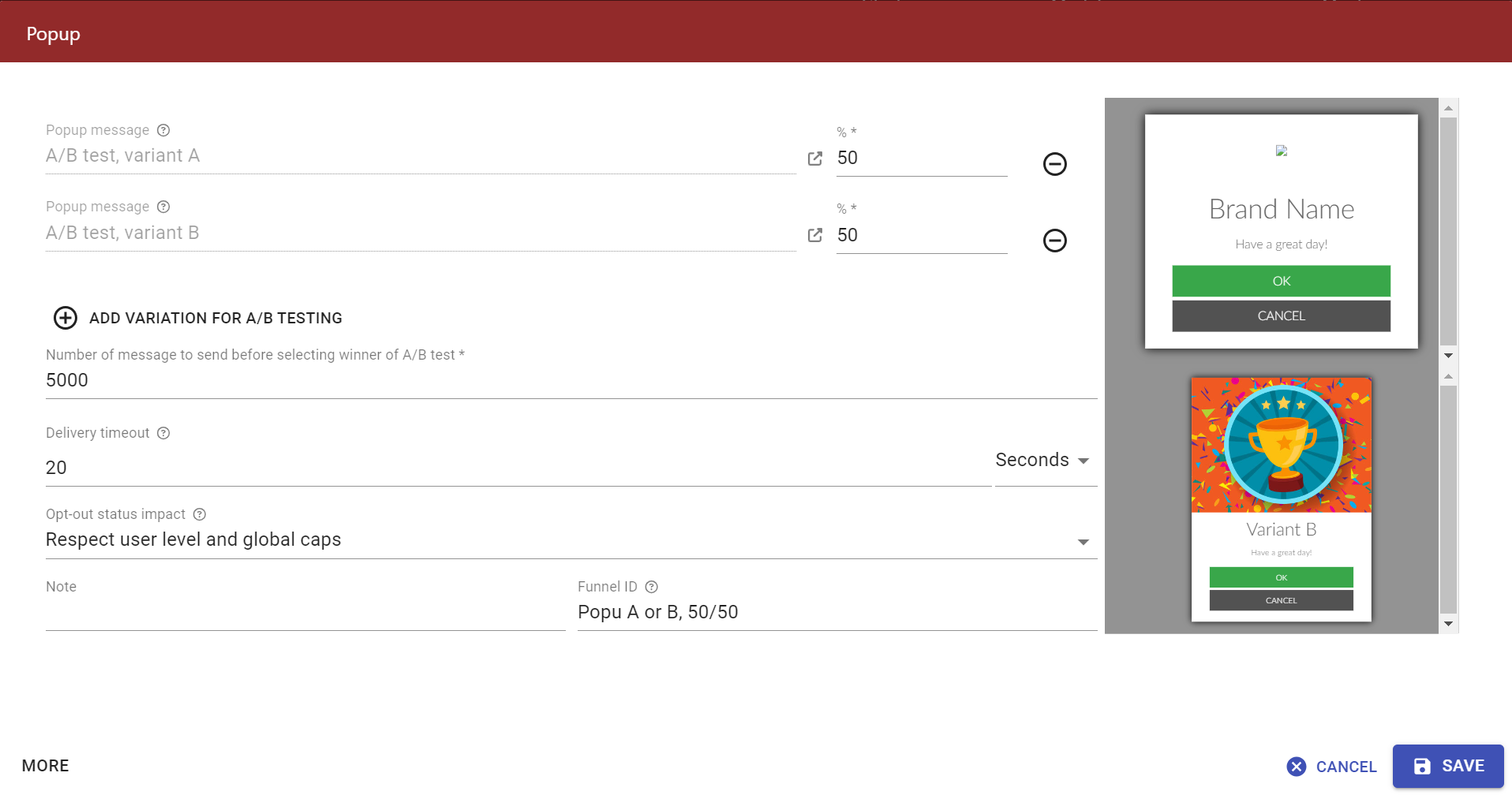
When creating the campaign flow, you can simply add the different versions of the asset, in our case the two versions of the pop-ups that you want to compare. You can choose the percentage of the audience who will receive Variant A and who will receive Variant B.
You can test multiple variations (two or more) within the same communication node, provided the total percentage across all variations equals 100%.
### In-Asset Testing vs. Split Traffic Node
Smartico provides two distinct splitting mechanisms depending on your testing goal:
* **In-Asset Communication A/B Testing (Single Node):** Used to compare multiple template variations within the same communication channel at a single step in the flow. It supports automated conversion tracking against an A/B target and automated winner selection after reaching a message threshold.
* **Split Traffic Flow Node:** A dedicated flow-control activity that splits incoming users across two or more separate journey branches according to defined percentage splits. Unlike in-asset testing, the Split Traffic node does not automatically select a winning branch; it permanently routes traffic between different journey paths, allowing you to test completely different communication sequences, delays, or reward strategies.
The **‘Number of message to send before selecting winner of A/B test’** option (default: 1,000) allows you to define how many messages (emails, SMS, pop-ups, push notifications, etc.) must be sent across all variations before the system evaluates and selects the winning variation. For example, setting this threshold to 5,000 means the system will distribute variations by the configured percentages until 5,000 messages have been sent, after which it evaluates conversion performance and routes all subsequent users to the winning asset.
{% hint style="info" %}
Keep in mind that if you are using the A/B testing in a Scheduled Campaign, the campaign should be recurring to determine the exact winner and to start sending only the winner. If the campaign is scheduled for one time the winner cannot be defined and the variations will be split the way they are defined in the communication asset.
{% endhint %}
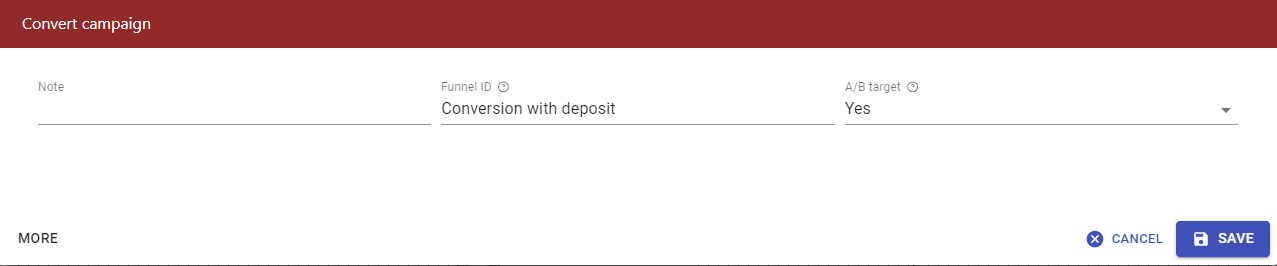
The winner of an A/B test is defined automatically based on how many users reach the downstream step marked as the A/B target. To designate a conversion goal, add a **Funnel marker** or **Convert campaign** activity after the message in the journey and turn on its **A/B target** switch. Only these two activities have this switch. Note that marking at least one downstream activity as an A/B target is required for automated winner selection; without an active A/B target node, conversion counts remain at zero and the system will never select a winning variation regardless of total messages sent.
An automated background evaluation process checks campaign performance on an hourly basis. Once total sends exceed the configured message threshold, the variation with the highest conversion rate (conversions to the A/B target divided by total entries) is selected as the winner. In the flow editor, the winning variation is badged with a checkmark showing its conversion statistics, and all subsequent users entering that activity will receive only the winning variation. If the message threshold is later increased, the winner lock is cleared and traffic splitting resumes until the new limit is met.
The results of the A/B testing can be found in the **A/B Testing & Incremental Lift Audit** report. To open it, go to the list of campaigns and click **Campaigns Analytics**. In the report, you can view the total audience entries, the number of converted users who reached the A/B target, and the resulting conversion ratio for each variation.
An earlier report of A/B test results. The current report is **A/B Testing & Incremental Lift Audit**
### Frequently Asked Questions
**How is the winner of an A/B test calculated?**
The winner is determined strictly by the conversion rate to the downstream step marked with the **A/B target** switch (calculated as users reaching the target divided by total entries for that variation). It is not determined by open rate or click-through rate unless the A/B target step (a **Funnel marker**) is placed after a click branch of the message.
**What happens if a campaign does not reach the message threshold?**
If the total sent messages do not reach the threshold (such as in low-volume campaigns or one-time scheduled blasts), the system continues to split traffic according to the configured percentages for every user. No automated winner is selected, but you can analyze the comparative conversion numbers manually in the A/B Testing & Incremental Lift Audit report.
**Can I run permanent random message rotation without selecting a winner?**
Yes. If you want ongoing random distribution across variations without locking into a winner, either set the message threshold to an exceptionally high number (up to 100,000,000) so it is never triggered, or use the **Split Traffic** activity node to distribute traffic between different message branches continuously.
**Can I test more than two variations in a single message activity?**
Yes. You can add three or more variations (A, B, C, etc.) to any supported communication activity. The only requirement is that the sum of the percentage distribution across all variations must equal exactly 100%.
**Which communication channels support in-asset A/B testing?**
In-asset A/B testing is supported across Email, Pop-up, Push notifications, Inbox messages, SMS, IVR, and instant messaging channels including Telegram, WhatsApp, Viber, and RCS.
---
# Agent Instructions
This documentation is published with GitBook. GitBook is the documentation platform designed so that both humans and AI agents can read, navigate, and reason over technical content effectively. Learn more at gitbook.com.
## Querying This Documentation
If you need additional information that is not directly available in this page, you can query the documentation by asking a question.
Perform an HTTP GET request on the following URL with the `ask` and `goal` query parameters:
```
GET https://help.smartico.ai/welcome/products/crm-automation/a-b-testing.md?ask=&goal=
```
`ask` is the immediate question: it should be specific, self-contained, and written in natural language.
`goal` is what the user is ultimately trying to achieve, the reason they need the answer. Sharing it helps GitBook give you a better, more relevant answer. A goal is most helpful when it describes the outcome the user wants rather than restating the question. For example, with `ask=how do I create an API token`, a goal like `automate deployments from our CI pipeline` lets GitBook tailor the answer to that use case.
The response will contain a direct answer to the question and relevant excerpts and sources from the documentation.
Use this mechanism when the answer is not explicitly present in the current page, you need clarification or additional context, or you want to retrieve related documentation sections.