> For the complete documentation index, see [llms.txt](https://help.smartico.ai/welcome/llms.txt). Markdown versions of documentation pages are available by appending `.md` to page URLs; this page is available as [Markdown](https://help.smartico.ai/welcome/products/crm-automation/activities-of-flows/activity-email.md).

# Activity: Email

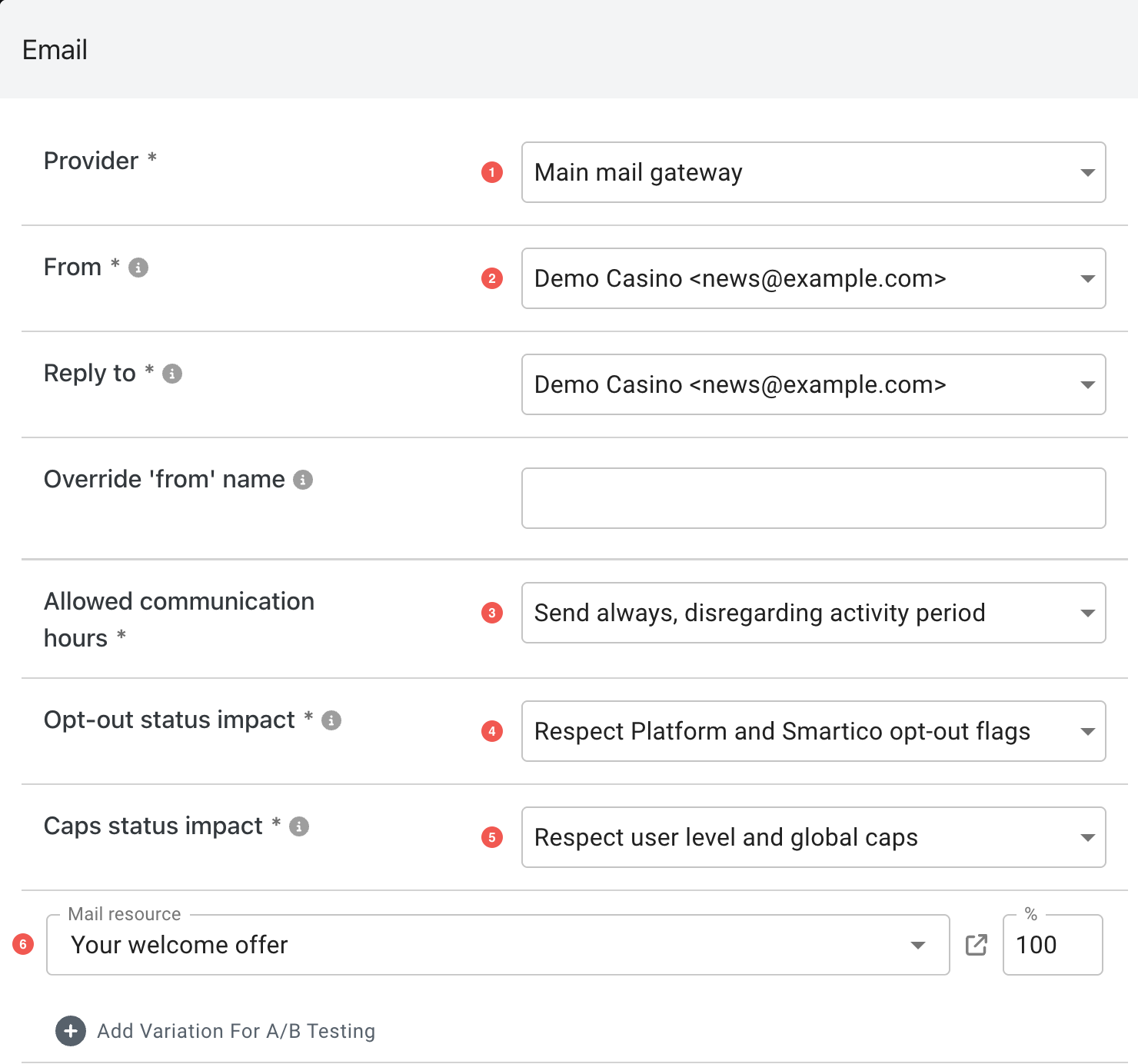
The email activity is used for sending a communication to the end users via Email and it is an offline activity since it does not require the user to be online. In the email activity, the operators can configure the following options:

1. **Provider** - choosing the email provider that will be used for sending the email. Operators can also choose the Automatic Selection (multi-brand setup).
   * Automatic Selection (multi-brand setup) - used to automatically select the mail gateway whose conditions best match the user; if no gateway with conditions matches, the gateway that has no conditions (the default one) is used. By default the first condition is Brand, but you can add more user properties to the email gateway. This gives you more flexibility when you want to filter a specific segment of users to use different Mail Gateway, for example.
   * When you choose a specific gateway, also pick **From** and **Reply to** from the addresses set on that gateway.<br>
2. BCC - send a copy of an email to recipients whose email addresses will remain invisible to everyone else on the thread. The field is controlled by the **Show the BCC field in Mail activities** setting in **Label settings**; ask your Success manager to change it. While the setting is off, no BCC copy is sent, even if the activity has a BCC address.<br>

   <div data-gb-custom-block data-tag="hint" data-style="info" class="hint hint-info"><p>Note: Contact our Customer Support team to enable this feature. Only when enabled will the field become visible in the Email Activity for Campaigns.</p></div>
3. **‘Override ‘from’ name** - you can override the 'from' name that will be used when sending mail with the **‘Override 'from’ name'** option in the email activity. The name cannot contain `<`, `>` or `@`. For example, your current selection is 'John <<no-reply@company.com>>' you can now set a custom 'from' to be 'Elon', in the case mail will be sent from 'Elon <[no-reply@company.com](mailto:no-reploy@company.com)>’. This option also works in case of automatic selection of the gateway for multi-brand context.<br>
4. **Allowed Communication hours -** used to define how the flow should behave if the time of the sending is in the ‘Do not Disturb’ period of the user. Here operators have different options:
   * to send the email only in the activity period (the hours set in the **Mail sending hours** label setting, in the user time zone)
   * to send it always, disregarding the activity period
   * to send if possible and if not - in the next available activity period
   * to send in a specific hour according to the user's time zone
   * to send in a specific hour according to the UTC zone
   * to send in users BEST COMMUNICATION TIME - ‘Best time’ is the AI-based predictive model that can identify user behavior patterns and send Emails at the best time for every particular user. In **Best time selection mode**, operators choose **Next best hour, no matter of the day**, **Next best day and hour**, or **Next best hour or as soon as possible during current day**. If Smartico has no best time data for a user, the email is sent at once.

{% hint style="warning" %}

#### Common case

Consider any custom timing configured for communication activities - if you use delayed timing, connect follow-up activities with `Sent` or `Delivered`, not `Then`. Delayed timing includes Allowed Communication Hours, a specific send time, and AI Best Time.

This ensures that follow-up actions start only after Smartico dispatches the message. A `Then` connector progresses the flow as soon as the activity is processed.

This also applies to [Activity: SMS, RCS, Viber and WhatsApp](/welcome/products/crm-automation/activities-of-flows/activity-sms-viber-and-whatsapp.md).
{% endhint %}

{% hint style="info" %}
**'Next best hour or as soon as possible during the current day' -** by choosing this option if the Best Communication Time for players is not today or has already passed, the communication will be sent immediately as the element becomes active.
{% endhint %}

5. **Opt-out status impact -** used to define if communication should be blocked or sent based on opt-out status defined on the Platform side and in Smartico.

{% hint style="info" %}
Email is respecting flags stored in: **core\_is\_email\_disabled\_by\_platform** (managed by Platform) and **core\_is\_email\_disabled** (managed by Smartico)
{% endhint %}

Operators can choose to:

* respect Platform and Smartico opt-out flags
* ignore Platform and Smartico opt-out flags
* ignore Platform opt-outs, but respect Smartico
* ignore Smartico opt-out flags, but respect Platform

6. **Caps status impact** - used to define if communication should be blocked or sent based on caps defined on the user and/or global level. Operators can choose to:

   * respect user level and global caps
   * ignore user level and global caps
   * respect user level caps, but ignore global caps
   * respect global caps, but ignore user caps

   <div data-gb-custom-block data-tag="hint" data-style="info" class="hint hint-info"><p>CAP restrictions are not applied to accounts marked as test.</p></div>
7. **Send only if -** used to add conditions for vertical opt-out properties. This can help you to send emails based on whether a user has opted out of a specific category like casino, but to continue to receive emails for sport promotions.<br>

   <div data-gb-custom-block data-tag="hint" data-style="info" class="hint hint-info"><p>In order to appear in the "Send only if" condition field, the vertical properties should be first listed in label setting <strong>Mail opt-out properties for "Send only if"</strong>, to control email eligibility.</p></div>
8. **Mail Resource** - used to add the email asset that will be sent to the players. Here operators can add different variations of the email if they want to send it for A/B testing. When adding a second variation of the email asset you can define also the percentage of the audience to which the specific variation will be sent. The email asset has to be created first before sending the email communication.

<div data-with-frame="true"><figure><img src="https://77049817-files.gitbook.io/~/files/v0/b/gitbook-x-prod.appspot.com/o/spaces%2FfS5hl0PiysHtKAKMsQTe%2Fuploads%2FD1unnc5vjrvQcNLckziv%2Fr2-001-shot-1-c299abc7-18cc6a.png?alt=media" alt=""><figcaption><p>The Email activity: 1 — Provider; 2 — From and Reply to; 3 — Allowed communication hours; 4 — Opt-out status impact; 5 — Caps status impact; 6 — the mail resource, with Add Variation For A/B Testing</p></figcaption></figure></div>

### Outgoing connections

The Email step can have these outgoing connections. The picture shows each of them, connected to a Funnel marker:

<div data-with-frame="true"><figure><img src="https://77049817-files.gitbook.io/~/files/v0/b/gitbook-x-prod.appspot.com/o/spaces%2FfS5hl0PiysHtKAKMsQTe%2Fuploads%2Fs6hLqFleMtkdIneBoOPR%2F7b4e715f64-email-9ac738ea-a488f9.png?alt=media" alt="Outgoing connections"><figcaption><p>Outgoing connections of Email in a flow. The numbers match the table below.</p></figcaption></figure></div>

| #  | Connection                                             | When the player goes this way                                                                                                                                              |
| -- | ------------------------------------------------------ | -------------------------------------------------------------------------------------------------------------------------------------------------------------------------- |
| 1  | **Then**                                               | Right away, when Smartico starts the step. It does not wait for the result, so it also runs when the step fails later.                                                     |
| 2  | **Sent**                                               | The email provider accepted the email. This does not yet mean that it reached the player.                                                                                  |
| 3  | **Delivered**                                          | The provider confirmed that the email reached the player's mail server. Smartico also counts the first open or the first click as delivered. It can happen more than once. |
| 4  | **Impression**                                         | The email was opened: its tracking picture loaded, or the player clicked a link. Image blocking in a mail app can hide an open.                                            |
| 5  | **Any click**                                          | The player clicked any tracked link of the email, including the confirmation on the unsubscribe page.                                                                      |
| 6  | **Failed**                                             | The email failed for any reason: a wrong or blocked address, an opt-out, a provider error, a bounce or a CAP block. A bounce can arrive after **Delivered**.               |
| 7  | **Failed, CAP**                                        | The email was blocked by the [communication caps](/welcome/products/crm-automation/communication-channels/communication-caps.md).                                          |
| 8  | **Failed, bounced**                                    | The player's mail server rejected the email (a hard or soft bounce).                                                                                                       |
| 9  | **Opt out (shown as Click "unsubscribe")**             | The player confirmed the unsubscribe on the unsubscribe page. Opening the link alone is not enough. It also counts as **Any click**.                                       |
| 10 | **Click link contains... (shown as Click \~ "bonus")** | The player clicked a link whose address contains the text you entered (here: bonus). Tags like `{{label.xxx}}` are not replaced in this text, so they never match.         |

The list also has one **Click** connection for each tracked link of the chosen email template; its name shows the link. When a click branch fires, the step is closed by default and its other branches stop; you choose this when you connect the branch (**Close original engagement**: Yes / No). **Failed** branches also close the step.


---

# Agent Instructions
This documentation is published with GitBook. GitBook is the documentation platform designed so that both humans and AI agents can read, navigate, and reason over technical content effectively. Learn more at gitbook.com.

## Querying This Documentation
If you need additional information that is not directly available in this page, you can query the documentation by asking a question.

Perform an HTTP GET request on the following URL with the `ask` and `goal` query parameters:

```
GET https://help.smartico.ai/welcome/products/crm-automation/activities-of-flows/activity-email.md?ask=<question>&goal=<user_goal>
```

`ask` is the immediate question: it should be specific, self-contained, and written in natural language.
`goal` is what the user is ultimately trying to achieve, the reason they need the answer. Sharing it helps GitBook give you a better, more relevant answer. A goal is most helpful when it describes the outcome the user wants rather than restating the question. For example, with `ask=how do I create an API token`, a goal like `automate deployments from our CI pipeline` lets GitBook tailor the answer to that use case.

The response will contain a direct answer to the question and relevant excerpts and sources from the documentation.

Use this mechanism when the answer is not explicitly present in the current page, you need clarification or additional context, or you want to retrieve related documentation sections.